
Designing digital trust for a NEO bank
A mobile app experience that helps customers onboard and access loans without stepping into a branch—balancing speed, transparency, and confidence in a fully digital banking journey.
Case study
Overview
Constraints
How might we help users feel confident making financial decisions without human support?
Digital banking sounds simple — until you try to onboard.
Users dropped off midway through onboarding
Too much information upfront created hesitation
Loan requests were often rejected because users didn’t know their eligibility
Financial terms (interest, repayment) felt unclear
The experience felt like being asked to sign papers without fully understanding what they meant. And for a product that deals with money, that’s a serious problem.

The design approach focused on three principles :

1. Progressive disclosure
Don’t overwhelm upfront

Mobile App

People were willing to try digital banking, but not at the cost of clarity
Users don’t drop off because flows are long. They drop off because they’re unsure.
The absence of a physical branch made people uneasy
Users didn’t like “uncertain outcomes” especially with loans
Long forms created fatigue and
second-guessing
Financial decisions required confidence, not speed alone

-
Users moved through onboarding with less hesitation
-
Loan request flows became more predictable
-
Drop-offs reduced significantly at key steps
-
Users reported better understanding of loan decisions
-
The experience started to feel reliable, not just fast.


One Step at a Time
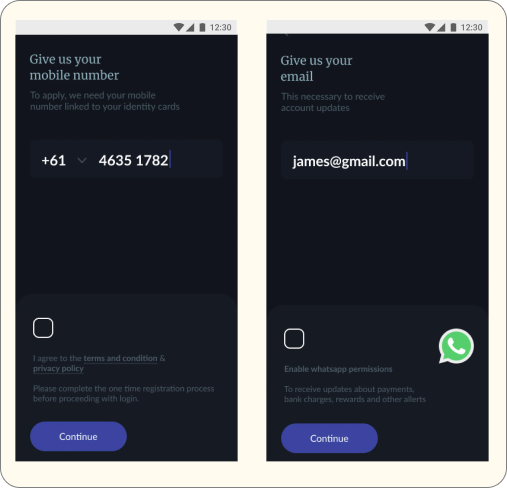
Instead of long forms, I broke onboarding into small, focused steps.
-
One input per screen
-
Clear instructions
-
Visible progress
This helped users stay focused instead of feeling overwhelmed.
Smooth, Interrupt-Free Onboarding
Reduced unnecessary friction points and keeping users in flow. Once they start, they shouldn’t feel interrupted.
-
Background validations instead of manual steps
-
Auto-reading OTP where possible
-
Minimal switching between apps
Understanding Users
Background
NEO banks promise speed and convenience. But without a physical branch, they also have a bigger problem to solve — trust.
I worked on designing the end-to-end onboarding and loan experience for a NEO banking product. The focus was to reduce drop-offs, simplify decision-making, and help users feel confident completing financial actions entirely online.
Context
NEO banks operate without physical branches. That changes everything.
-
No in-person reassurance
-
No human explaining next steps
-
Everything depends on the product experience
At the same time, traditional banks were already catching up digitally, reducing the perceived advantage of NEO banks
So the real question became:
How do we build trust, clarity, and confidence — purely through experience design?
Approach
Outcomes and Lesson learned
I spoke to users who were already using banking apps and some who had tried NEO banking. A few things stood out quickly.

2. Clarity over speed
Make every step understandable
The outcome through usability testing and validation
Onboarding flow
Loan Request flow
Design Decisions
I didn’t start with screens. I started with reducing decision anxiety.

Make Financial Information Understandable
Reducing uncertainty and confusion in loan requests, interest rates and repayment amounts.
-
Showing eligible loan amount upfront and allowing users to choose within that range.
-
Clear breakdown of loan amount vs repayment
-
No hidden calculations
Users felt informed before they committed.

Humanizing Digital Verification
-
Selfie-based verification
-
Clear feedback on process completion
-
Time expectations (e.g., verification takes ~10 mins)
This made the KYC process feel more transparent and less like a black box.

-
In fintech, clarity builds trust more than speed
-
Reducing uncertainty is often more valuable than reducing steps
-
Users don’t need fewer screens — they need better guidance
-
Designing for financial decisions means designing for confidence
3. Guided decisions
Guide users instead of guessing
